Whittington, Shropshire
Whittington is a historic village in north-west Shropshire, England, lying just east of the town of Oswestry in the West Midlands region. It is a peaceful rural community surrounded by countryside, with a population of around 1,600 people in the village itself and about 2,600 in the wider civil parish. Whittington combines a strong sense of local identity with a rich past, visible in its landscape, buildings, and long history of settlement.
Early settlement and landscape
The area around Whittington shows evidence of human occupation stretching back more than 3,000 years. Archaeological finds point to prehistoric activity, and the site may have held local significance during the early medieval period, possibly as a stronghold associated with King Cynddylan in the seventh century.
The village takes its name from Old English, indicating an established Anglo-Saxon settlement. Its location sits within a well-watered landscape shaped by glacial soils and a high water table, conditions that influenced grazing, farming, and later settlement patterns.
The Norman Conquest and the Welsh Marches
Following the Norman Conquest of 1066, Whittington became part of the Welsh Marches, the contested borderlands between England and Wales. The term Marches refers to borders rather than marshland, but the local geography of damp soils and reliable water sources played an important role in how the land was used and defended.
Whittington is recorded as an extensive settlement in the Domesday Book, reflecting its early importance.
Around this time, Whittington Castle was likely founded, probably by William Peverel. The earliest castle was a wooden motte-and-bailey structure, positioned to control movement through the border region. Its moat and setting made effective use of the naturally wet ground.
Routes, movement, and border life
Although not a destination in itself, Whittington lay close to long-established routes linking London and the English Midlands with North Wales, including Anglesey. These routes were used by traders, officials, pilgrims, and armies alike.
The village’s position near these corridors of movement helps explain both the presence of the castle and the later establishment of religious and military estates nearby. Whittington functioned as part of a wider landscape shaped by passage, exchange, and control.
Civil war and consolidation (12th century)
The first documentary reference to Whittington Castle appears in 1138, during The Anarchy – the civil war between King Stephen and Empress Matilda. The castle was fortified during this period and began to be rebuilt in stone, marking its role as a permanent feature of the border.
Throughout the 12th century, Whittington remained closely tied to wider political struggles affecting the Marches.
The FitzWarin family and Welsh conflict (late 12th–13th centuries)
From the late 12th century, the castle and lordship of Whittington became closely associated with the FitzWarin family. Fulk FitzWarin III’s prolonged dispute with King John, which included a period of outlawry, became one of the most dramatic episodes in the village’s history.
In 1223, the castle was captured and destroyed by Llywelyn ab Iorwerth. Later that year it was returned under a peace settlement and rebuilt fully in stone. Much of the castle’s surviving layout dates from this reconstruction.
As the border gradually became more stable, the castle’s defensive role diminished and parts of it were adapted for more domestic use.
Religious orders and estate land
During the medieval period, the Knights Hospitaller established a commandery at nearby Halston. Their presence reflects Whittington’s position within a network of routes and border estates rather than any single religious destination.
Hospitaller estates were practical, income-generating centres that supported care, hospitality, and administration in regions shaped by movement and uncertainty.
Decline of military importance (14th–15th centuries)
By the early 15th century, Whittington’s strategic importance had declined. In 1404, during the uprising led by Owain Glyndŵr, the village of Whittington was burned, although the castle itself was not taken.
Following the death of the last male FitzWarin heir in 1420, ownership of the castle passed through marriage and inheritance, leading to disputes and changes in control.
From fortress to estate (16th–18th centuries)
In 1545, the lordship of Whittington was exchanged with King Henry VIII. A contemporary survey described the castle as “in decay,” suggesting it was no longer inhabited.
Over time, the castle became part of the Aston estate, owned by the Lloyd family of Aston. Under the Lloyds, the castle was treated as a working estate asset rather than a defensive structure. Stone from collapsed sections was reused locally, and parts of the site were adapted for agricultural and domestic use.
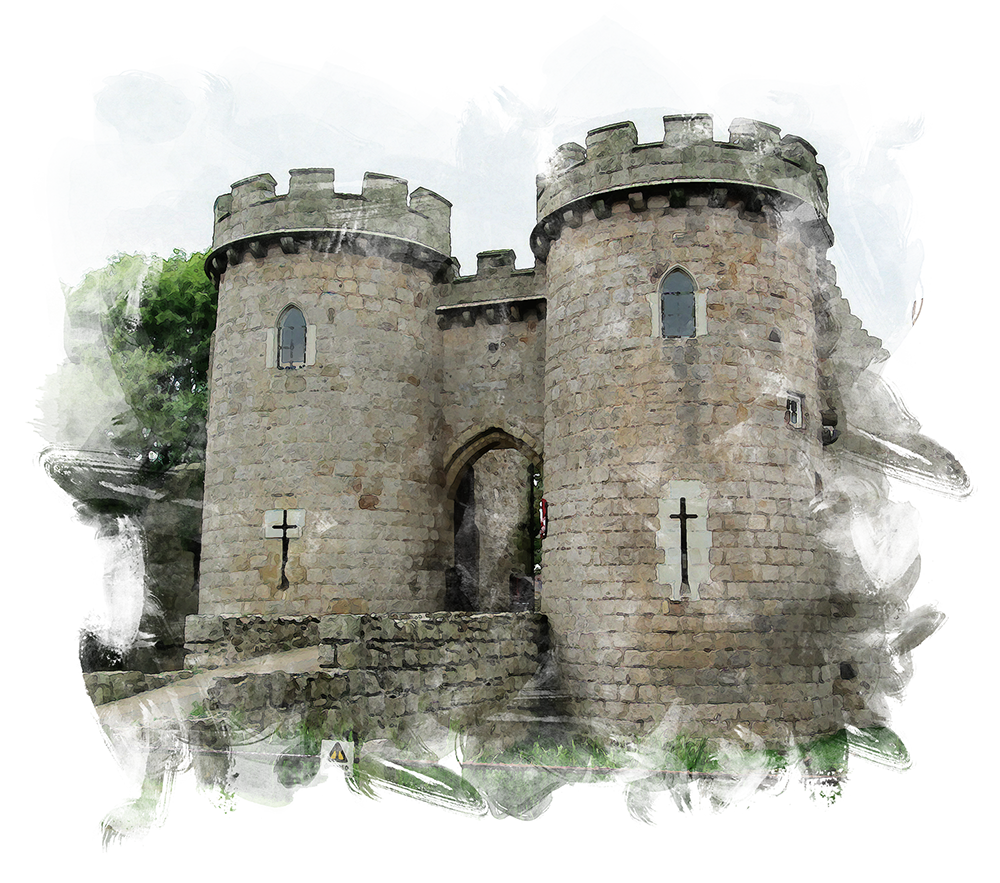
In 1673, the gatehouse was let as a dwelling, and in the early 19th century William Lloyd undertook repairs that allowed it to function as a farmhouse.
Survival, restoration, and care (19th–21st centuries)
The Castle gatehouse remained inhabited until the late 20th century. While much of the castle remained a ruin, its continued use helped prevent complete loss.
In 2002, the Lloyd family granted a 99-year lease to the Whittington Castle Preservation Trust, who now oversee its conservation, repair, and public access. The castle has since become an important local landmark and a visible link to the village’s long history.
Whittington today
Today, Whittington is a living village shaped by layers of settlement, border politics, land use, and community life. Its castle, church, streets, and green spaces reflect centuries of change, while ongoing care and stewardship continue to shape how its history is understood and shared.
This page offers an overview of that story; further detail and sources will be added as the Whittington Remembers archive develops.